Least-Vulnerable Load Balancing
Round robin and least connections pick a backend by load. We add a third signal: which of your stacks is exposed to an exploitable vulnerability right now.
- A scoped IAM role that can edit backend weights on one load balancer. Nothing else.
- A signed SBOM per deployed image, from your existing pipeline.
- Your approval policy: what moves automatically, what pages on-call.
Your traffic, your data, your source code, or shell access.
Eight steps, every one logged
Detect
Pull OSV.dev, CISA KEV, FIRST EPSS, distro and FreeBSD advisories, and signed VEX statements.
Match to you
Join each advisory against the signed SBOM of the image that is live, not the one in Git.
Score risk
Known exploited beats likely beats theoretical. VEX "not affected" lowers the score.
Safety checks
Capacity guard, dwell timers, feed freshness and signatures.
Approve
Auto for small shifts; on-call approval for hard cuts, per your policy.
Reroute
Write new backend weights through the load balancer's config API.
Verify
Confirm the config landed and the receiving stack stays healthy; roll back if not.
Report
Decision record with evidence, to Slack, email or your SIEM.
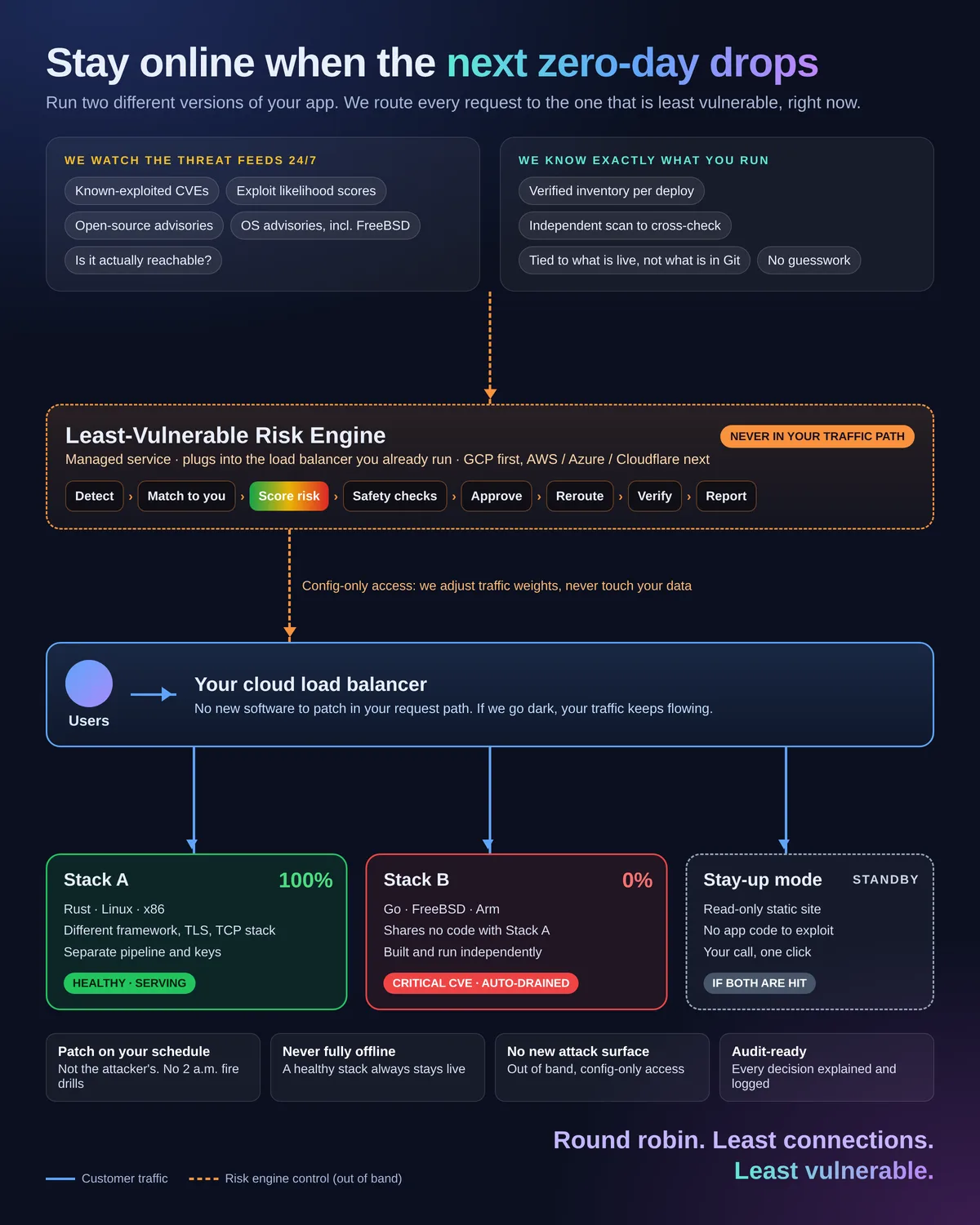
Designed so the cure can't cause the outage
If both stacks are hit, weights hold and we page you.
Hysteresis and minimum dwell time before any reversal.
Stale or unsigned feeds freeze changes. If we disappear, your LB keeps its last config.
A read-only static version of your site, one click away, for when both stacks are exposed.
Works with the load balancer you already run
We're building GCP first. Tell us what you run and we'll prioritize.
GCP Global LB
Backend service weights via the Compute API.
AWS
ALB weighted target groups.
Azure
Front Door origin weights.
Cloudflare
Load Balancing pool weights.
Get early access
We are onboarding a small design-partner group, GCP Global Load Balancer first. One email when your slot opens; nothing else.